
Parental Transition
Jul 05, 2026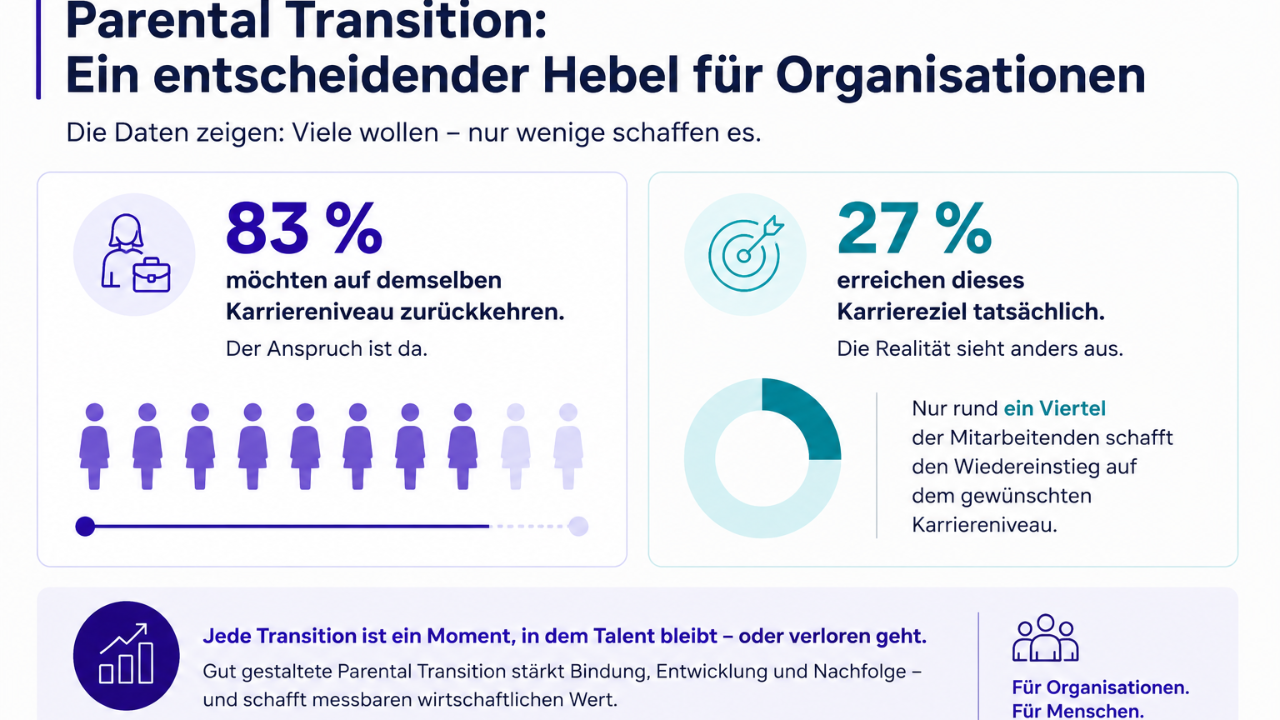
Viele Unternehmen verfügen heute über gute Elternzeitregelungen, flexible Arbeitsmodelle und Angebote zur Vereinbarkeit.
Der Unterschied entsteht dort, wo der Übergang aktiv gestaltet wird: vor der Elternzeit, während der Abwesenheit und beim Wiedereinstieg.
Genau hier entscheidet sich, ob Mitarbeitende ihre Karriere fortsetzen, Potenzial sichtbar bleibt und Führungskräfte Entwicklung aktiv ermöglichen.
Die Daten machen die Lücke deutlich:
83 % möchten nach der Elternzeit auf demselben Karriereniveau zurückkehren.
Nur 27 % gelingt das tatsächlich.
Die relevante Frage lautet deshalb nicht:
Haben wir gute Elternzeitregelungen?
Sondern:
Wie stellen wir sicher, dass Talente ihre Entwicklung fortsetzen und im Unternehmen wirksam bleiben?

„Parental Transition darf nicht dem Zufall überlassen werden“
Wie dieser Perspektivwechsel in der Praxis gelingt, haben wir mit Aneta Anđelić, Head of Attraction, Learning & Development, HypoVereinsbank - UniCredit - Deutschland, besprochen.
Many companies invest heavily in recruitment and talent development. So why do they still lose talent at the very moment when employees become parents?
Many organisations invest significantly in attracting and developing talent, but often underestimate the impact of major life transitions. Becoming a parent is one of the most significant transitions in a person's life. It affects priorities, identity, confidence and career expectations at the same time. If this phase is not actively supported, uncertainty can arise around future career opportunities, communication, and expectations. For organisations, parental transition should therefore not be viewed as an administrative process, but as a critical moment in the employee lifecycle that has a direct impact on engagement and retention.
What makes the difference between a successful and an unsuccessful transition?
The difference lies in whether the transition is managed intentionally or left to chance. A successful transition is characterised by early dialogue, clear expectations, transparency and ongoing connection throughout the leave and return journey. Employees need clarity about what will happen before, during and after parental leave, while managers need guidance on how to support their team members through this process. An unsuccessful transition often occurs when communication becomes irregular, expectations remain unclear or career conversations are postponed. In such situations, employees may feel disconnected from the organisation and uncertain about their future opportunities.
What impact does a poorly managed parental transition have on talent retention, career development and succession planning?
When parental transitions are not managed effectively, organisations risk losing talent, critical knowledge and future leaders. Employees may return with reduced engagement, decide to leave shortly afterwards or perceive fewer opportunities for progression. This can create gaps in succession pipelines and reduce the diversity of future leadership talent. Over time, these individual outcomes accumulate and can have a significant effect on retention, workforce planning and leadership continuity.
Many companies invest in programmes to advance women’s careers. Why are these measures not enough if parental leave processes are not taken into account?
Career advancement programmes are important, but they often focus on development opportunities while overlooking the moments where career progression is most at risk. Parenthood remains one of the most influential points in many women's careers. If organisations invest in mentoring, leadership development or other development programmes but do not address parental transition, they risk losing the impact of those investments during a critical career stage. Supporting women’s careers therefore requires a lifecycle perspective.
You introduced structured support for parental transition. What exactly did you do, what has changed since then, and what surprised you?
We introduced a structured parental transition approach that supports employees before, during and after parental leave. The objective was to provide more clarity, consistency and guidance for both employees and managers throughout the process. We started with a pilot phase to better understand employee needs and gather feedback before scaling the programme. Alongside coaching and support resources, we focused on creating more structure around leave and return conversations and helping managers navigate these discussions with confidence. Since then, we have seen more transparent communication, clearer expectations, and a stronger sense of connection throughout the transition. Conversations are more focused, employees feel better informed and managers have a clearer framework to support their teams. We also have a dedicated Stay Connected Portal, which plays a central role in maintaining engagement during parental leave. For the duration of their leave, employees are encouraged to but do not have to, stay connected through the portal, which mirrors relevant content from the Business Desktop and provides access to key resources, including return-from-parental-leave forms and the internal job portal. The platform also keeps colleagues informed about important developments across the Bank, helping them maintain a sense of connection while away and making their return to work smoother and more seamless.
2TOP Parental Transition Programm
Wo Organisationen Talent sichern
Unsere Erfahrung aus Projekten in großen Organisationen zeigt:
Nicht die Elternzeit entscheidet darüber, ob Talente bleiben. Entscheidend ist, wie Organisationen den Übergang gestalten.
Vor der Elternzeit werden Erwartungen, Rollen und Perspektiven geklärt.
Während der Abwesenheit geht es darum, Verbindung und Sichtbarkeit aufrechtzuerhalten.
Beim Wiedereinstieg entscheidet sich, wie schnell Mitarbeitende wieder Wirksamkeit entfalten und ihre Entwicklung fortsetzen können.
Genau an diesen Punkten setzt das 2TOP Parental Transition Programm an: mit individueller Coaching-Begleitung, Leadership Enablement, klaren Leave-&-Return-Prozessen und der Integration in bestehende HR-Strukturen.
Parental Transition ist kein zusätzlicher HR-Prozess.
Sie ist ein Prüfstein dafür, wie gut eine Organisation mit ihren wichtigsten Talenten umgeht.
Organisationen, die diesen Übergang strategisch gestalten,
- reduzieren vermeidbare Fluktuation,
- sichern die Wirkung ihrer Investitionen in Recruiting und Talententwicklung,
- stärken ihre Leadership-Pipeline
- und schaffen bessere Voraussetzungen für eine erfolgreiche Nachfolgeplanung.
Parental Transition als Business Case
Wie hoch sind die Kosten einer schlecht begleiteten Parental Transition? Welche Faktoren entscheiden darüber, ob Talente bleiben oder gehen? Und warum reichen klassische Förderprogramme allein nicht aus?
In unserem White Paper zeigen wir:
- welche wirtschaftlichen Auswirkungen Parental Transition hat,
- warum klassische Förderprogramme allein nicht ausreichen,
- welche Faktoren über Retention und Karriereentwicklung entscheiden,
- und wie Organisationen Parental Transition als strategischen Business Case gestalten können.
Wenn Sie das Thema aktuell beschäftigt
Wenn Sie an Talentbindung, Nachfolgeplanung oder Führungskräfteentwicklung arbeiten, lohnt sich eine einfache Frage:
Wie gut nutzt Ihre Organisation den Übergang rund um Elternschaft als strategischen Talentmoment?
Gerne sprechen wir mit Ihnen darüber, welche Hebel in Ihrer Organisation den größten Unterschied machen.